Attention Economics and Software Engineering
For a long time I was wondering why worthless subjects get lots of attention, while something real stays in a shadow despite being visible. I miss the old internet with high rate of competent and motivated people. At some moment the whole internet thing just turned into a big mall, with playgrounds, shops, fastfood, and lots of ads — the marketing and self-promotion irreversibly passed some critical threshold a long time ago.
You can look at the problem from another angle. Thousand years ago you needed to travel to another country to get knowledge or some people from your tribe died showing you an example of wrong behavor. Genetically people are still functioning as if the information was scarce. Then we got magazines, radio, tv, internet, and now the man expects to be spoon-fed with information — a suggestion to perform an active information search seems almost like an insult today, at best he will prompt perplexity to perform the search, coz he’s busy watching tiktok to waste the precious time on the manual search.
It’s what I usually call “conspiracy of stupidity” — the people secretly conspired to act irrationally and pretend to be acting to their own detriment, supposedly chasing some secret profit goal (that’s was joke, but there’s some truth in it). I pay attention to the way I shit (in a toilet), but I don’t share any details of the process with broad public. If a single actor shouts in a concert hall — everybody hears him; but if every man in the hall shouts then nobody is able to hear anything but the noise.
I need to pick some random examples to show you more details, but do remember this is a biased cherry picking.
Recently I passed by Jeff Geerling’s blog. Never heard of him, despite the fact I employ Linux for decades. He’s a classic example of strategic visibility seeker: doing low effort work to achieve high visibility and attention.
(also called “narcissist” in professional psychological circles, but I’d rather avoid simple labels for non-psychologists audience)
5000+ people contributed to Ansible development, while Jeff Geerling managed to snatch a significantly disproportioned amount of attention by being focused on the final polish. He also made a show out of drupal migration between adjacent versions, while somewhere in the dark corner cries a web dev who makes three migrations a week freelancing on upwork. Unfortunately, the whole body of Jeff’s work is pretty much useless for any serious professional Linux user, but the professionals were never his target audience anyway, so everything is okay here.
Decades ago I was young and stupid, so I was an open source activist. And very quickly I became dissapointed by the fact that most people just don’t give a shit about what they use and how they use it, and especially who made it. Noteworthy, the smartest of us found jobs in large corporations — that’s pretty much how open source got any serious value i.e. Google/RedHat/IBM investing into Linux for their own purpose.
I can rephrase the idea: it is absolutely not possible to organize any large software development with community effort only — people start chasing shiny fluff and totally forget about core things. (and it’s also how IT startups get funding by making fake promises)
Yes, there was GNU project, but it was a very narrow group of people not able to compete with large corporations.
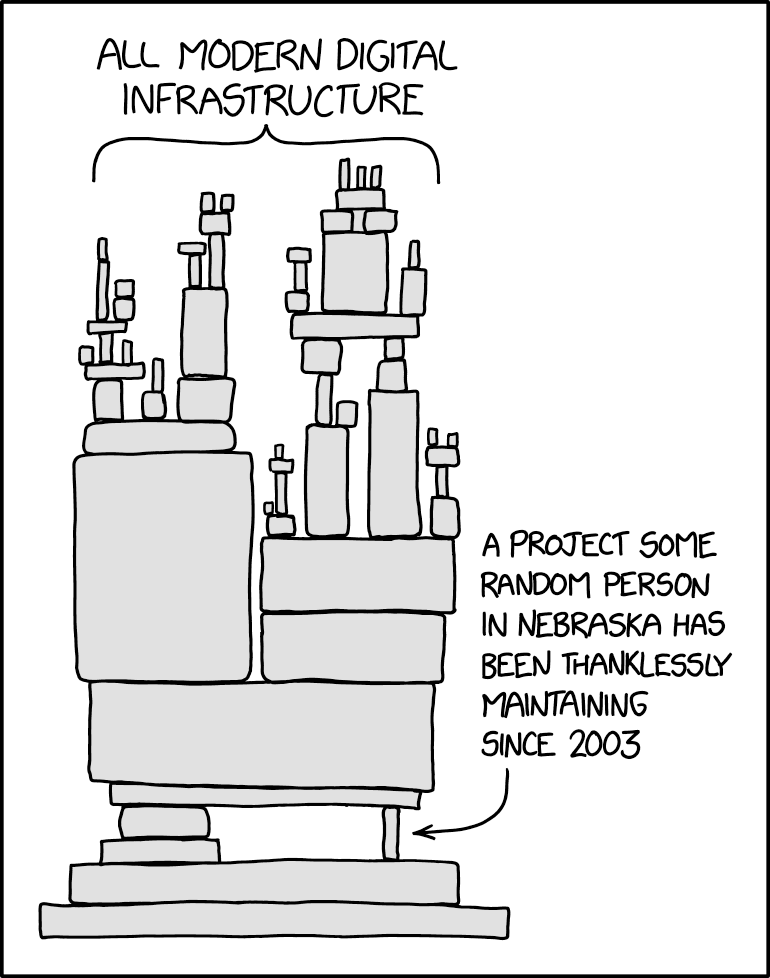
At those times I recall solving a long standing bug in glade3 to support non-visual components — which glade3 could not support because of broken references/lifetimes nobody was willing to fix because this kind of work does not provide quick immediate reward (and I got paid by Google for doing that). I was so exhausted and was thinking like “is the software development all like that?”. Yes, I’ve got some bloggers recognizing my work and even one job offer, but I could have spent 90% of this time on attention hunting instead — and achieve much more results in the end. In the new age you really need to get into people’s face to make them see you.
Recently I got a story of a dude being interviewed for some infrastructure engineer position, and he left in just 20 minutes after failing to solve the very first practical task — because (retelling his words) he was above the dirty job of fixing an actual production problem. I cannot describe you how much of a red flag this behavior is, because infrastructure engineer hoarding low effort success stories while dodging responsibility and avoiding problems is a recipe for disaster.
Sorry, not sharing his CV for privacy reasons, but believe me it’s full of narcistic signs of visible success stories.
You can call me jelous, but at least Jeff Geerling was really doing something with his own hands: he was writing articles, he was writing small configs, ansible roles, making videos. He was making noise, but this noise had limited extent.
Today’s kids got heavy weaponry in their hands — the LLM-based AI. For example:
https://github.com/theMackabu/
Dude copyied large chunks of Elk.js interpreter:
https://bykozy.me/static/elk_vs_ant.png
and vibecoded new functions with heavy code duplication:
https://bykozy.me/static/ant_diff.png
https://bykozy.me/static/ant_diff2.png

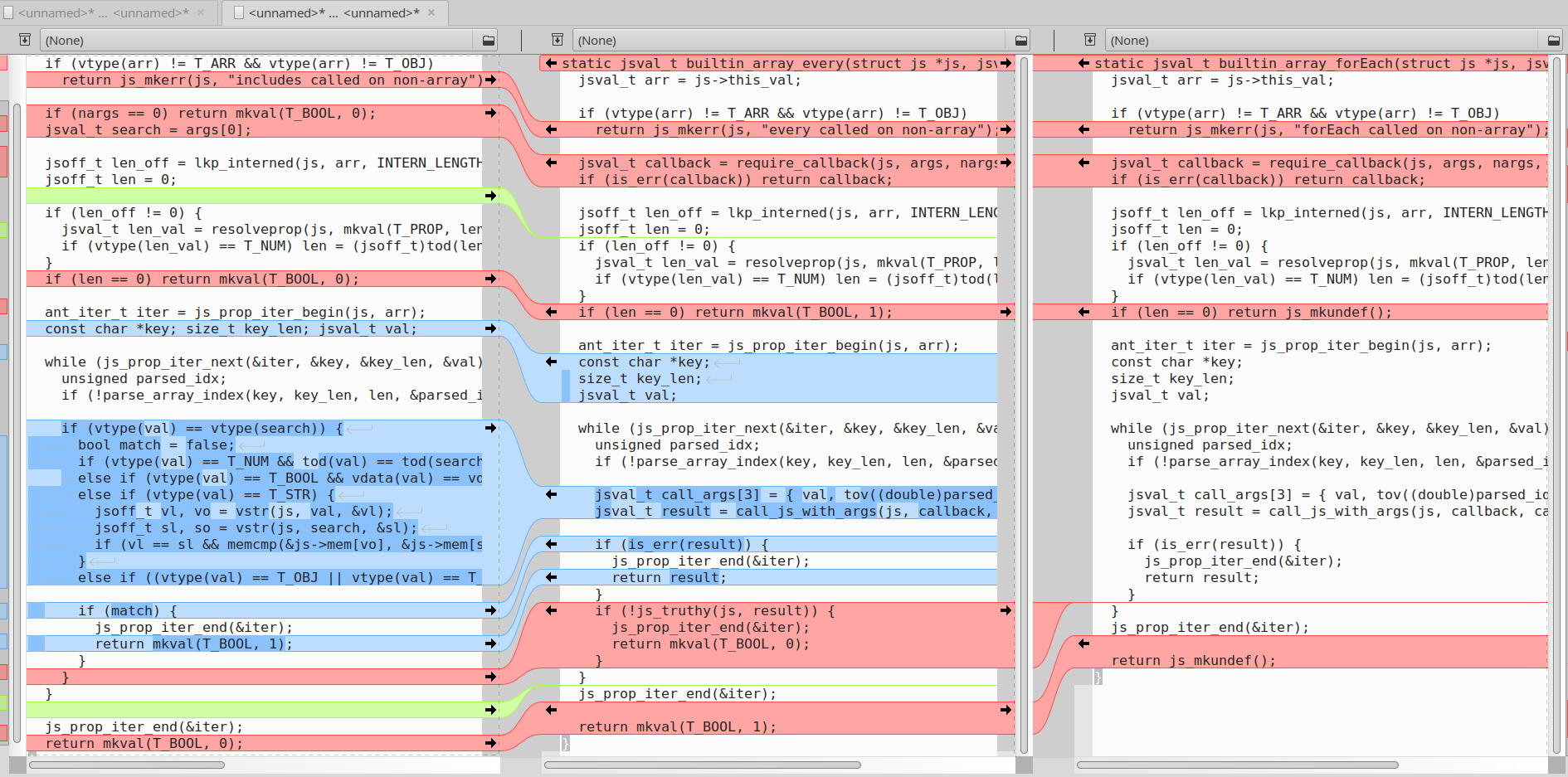
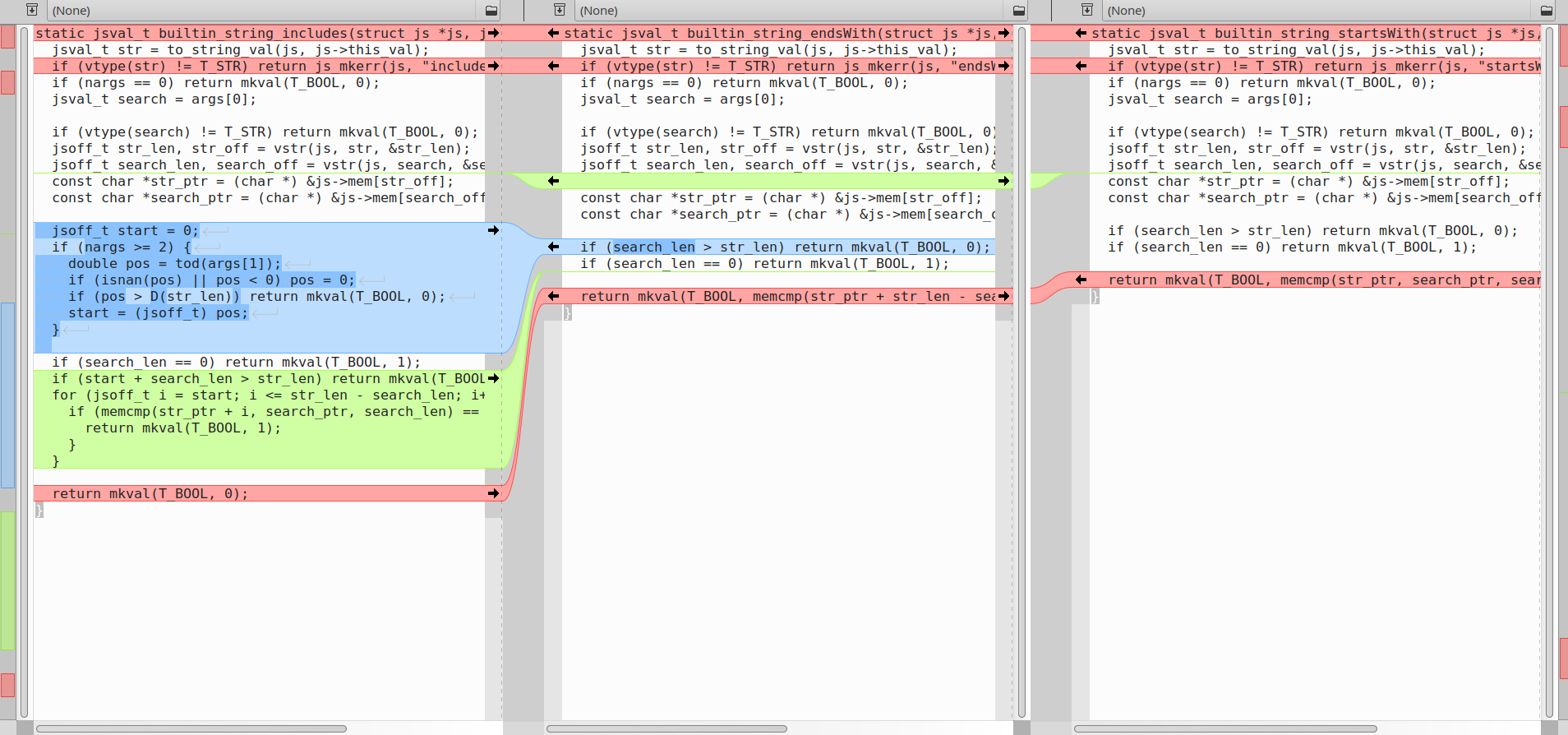
500 new lines each day, 2000 total lines added-modified-deleted per day — and he called it all his own work, thus violating Elk.js licence (you cannot publish the modified GPL software under MIT license).
Want more examples?
https://github.com/tiagozip/cap — recently created project, already having 4900 stars. It almost feels like the kids are playing github like it’s Roblox.
Cap is basically Altcha reimplementation, but without multi-language backend support and implemented from scratch as a mess of descrete JS subproject with hardcoded cdn.jsdelivr.net references. And the whole idea of proof-of-work in browser is just meaningless anyway, you create more problems for genuine users than you do for hackers with 3090 GPU-s.
The biggest new threat here is that you cannot immediately whether some repo is fully made out of AI slop. I know it because people genuinely shared the repo with me, like “look what a greaat job this guy did”. Ten years ago you could immediately tell the github repo was made by a kid, now you cannot. It’s not like I’m against kids — any human can reproduce the effort. But now the signal-noise level is threatening.
Don’t get me wrong — I’m totally fine with another student writing another fancy thing. I’m rather not fine with people spending their time following a pack of narcistic content makers on twitter/instagram instead of spending this time more productively e.g. playing Dota or taking a walk, with more positive impact for themselves. In Dota you have 9 weird players in one game, in twitter you put your head into a bin filled with garbage produced by hundereds of noise-makers, most of whom do not give a shit about what they write. Nobody’s imposing social networks, but people are rather deliberately destroying their sanity just to forget how miserable their lives are otherwise.
The broader picture
And I’ve just figured out the recent trend is not incidental after all. Considering the global trend for islamisation and regional isolation, the economies no longer need people who invent and create — it is not “cool” anymore (at least you should thank it’s not nazis again, despite the fact they were a viable alternative actually). The declining/stagnating economy needs people marching together and believing everything imposed via social media. 99.9% of people should be consuming and reproducing without questioning, while <0.1% hoard the knowledge and skill to control the consumption machine. That is, a state-level actor owns a smartphone-making factory and few engineers there know how smartphones work, while nobody else on the planet knows how these devices work. And nobody’s even trying to steal the knowledge, except for state actors from other regions, because the tech is hard to commercialize anyway.
Some time ago IT mainstream was “growth at all cost”, now it’s “we just reproduce best practices”. Sad but true: there was really no space for “build good reliable software”. Repercursion of those incentives is that most developers (like 95-98%) have no clue what reliable and maintainable software is. Not because they are irresponsible or incompetent — it’s exactly the opposite: they were taught, they read articles, books, learned from teammates, and never questioned status quo, because in the end they were examined and accepted by the same people reading same books, and there were no external incentives to change. “If it ain’t broke — don’t fix it”, right? Well, the problem is it was actually often times broken, but most people never saw alternatives. Nowadays Amazon Games failing three projects in a row seems almost normal, because in a large company building a reliable software is an incident rather than a deliberate effort.
The “Pause Giant AI Experiments” was really a nonsence, you can see it with your own eyes that every spare dollar in 2025 and 2026 was used for AI, despite AI not becoming “better” but rather “bigger and cheaper” — so this is a deliberate effort for distraction and destruction, not incident. Yet most of todays AI bubbles will be gone in just few years, so I don’t really see any additional value in putting so much money into it.
And if you are at least 20 years old then you can also see that we are not getting more new software but rather getting more of the same, and the quality of the new copies actually degrades rapidly. What’s being created en-masse are new packaging options, different flavors of the same, but the core remains unchanged. People generate lots of react-based websites, but they all look and behave the same.
So the big actors actually gave the weapons of mass informational destruction to all the kids — that’s how I can describe the situation with few words.
You may call it “economic incentives actively reward the very behaviors that degrade information quality” — it does not really matter.
https://bfi.uchicago.edu/wp-content/uploads/2025/04/BFI_WP_2025-56-1.pdf — Large Language Models, Small Labor Market
despite substantial investments, economic impacts remain minimal. Using difference-in-differences and employer policies as quasi-experimental variation, we estimate precise zeros: AI chatbots have had no significant impact on earnings or recorded hours in any occupation, with confidence intervals ruling out effects larger than 1%.
Or another source:
https://hbr.org/2026/02/ai-doesnt-reduce-work-it-intensifies-it — AI Doesn’t Reduce Work—It Intensifies It
And another:
https://arxiv.org/abs/2507.09089 — Measuring the Impact of Early-2025 AI on Experienced Open-Source Developer Productivity
In other words, by 2025 there is exactly zero economic effect out of LLM-s — it is well known to every big actor. This course for noise-generation and disruption of skill transfer chain was a slow ongoing effort, now it became the explicit goal.
If you were to employ some new library or programming language — ready-made LLM-s would no longer help you write your software. And to write the new old software you require Cursor subscription instead of a human teacher. And anyway junior developers cannot find jobs because the COVID is over. So the existing technologies are pretty much carved in stone from now on. Yes, you can change button’s color or label, but you cannot change the framework it was built on.
For example, I would argue that user interface is one of the most demanding parts of software development, yet recently it used to be implemented by people with neither engineering nor cognitive psychology skills. No surprise today it ends up as “we would just write a prompt for AI” — not because it’s easy, but because consumer’s expectations are lower than ever.
Same thing goes in art: you can paint a picture, but now there are hundred kids who can paint similar picture with AI — so you are just “one of hundreds” after all. Despite the fact AI is basically reproducing pieces of existing works, which means AI actually needs the new original content, but the incentives are broken and the content creation is not feasable — reactions and sob puppy rescue video are the new age “content creation”.
Want some movie examples? Watch the “Matrix: Reloaded” 2002 movie to cry about how good special effects were back there and how terrible they are in the recent “Avengers” or “The Batman” (2022). Mark my words — it’s gonna get worse.
Take a look at stackoverflow — it used to be one of the key sources for AI training data, but now stackoverflow is effectively dead. And you’ve all likely encountered the repercursions of tis death in the form of AI giving you a correct solution for older version of software, but not able to adapt the solutions to the newer software versions.
There is no solution
It might seem a bit counterintuitive for a society where everyone wants to be an instagram star, but the actual developers doing high impact work often time prefer to hide from the information storm in some private discord channels or other completely closed spaces with zero discovery. Because the low effort noise is actually destructive: you get lots of users, every user wants to tell everyone how good he is, then you get spammers selling some crap to these users, and now your whole platform is drowned in a shit bouncing between the walls.
Ironically, talking about islam once again, there was a sufi culture that used to also hide from the religion monopoly in plain sight. It hid so well that nowadays few people really know who sufis were — widespread image of sufis is just a parody of the real sufis. I actually know one non-IT professional who strictly forbids calling his name anywhere in the social media — yet his students are all over these social medias. I can reiterate it: most people absolutely have no clue how an expert looks like and how he does his work. And it’s gonna get worse.
This global status quo is here and you cannot change it, you can only minimize the damage for yourself.